
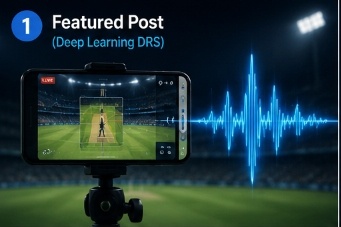
Until recently, tracking a cricket ball at high speed and reconstructing its 3D flight trajectory was a luxury reserved exclusively for professional broadcast setups. These setups utilize up to six high-frequency cameras running at 250 frames per second, calibrated precisely around the field. Today, deep learning architectures are breaking these hardware barriers, letting any coach or club player track ball vectors using a standard smartphone camera.
On-Device Object Detection
A cricket ball moves at speeds of 100km/h to 150km/h. On a standard smartphone camera recording at 60fps, the ball appears as a fast motion blur rather than a distinct red sphere. To overcome this, CricsApp uses custom-trained neural networks optimized for mobile GPUs:
- Frame Isolation: The system isolates individual frames and processes them through a lightweight CNN detector to isolate ball centroids, even when heavily distorted by motion blur.
- Kalman Filtering: Since a bowler's hand release can mask the initial ball trajectory, mathematical models predict the trajectory vector by mapping the visible portion of the flight path.
- Calibration: Using key field indicators (wickets, batting creases, and pitch boundaries), the app calibrates the camera's lens parameters to build a virtual 3D coordinate space.
Translating Pixels to Insights
Once the flight coordinates are mapped, CricsApp translates this raw data into pitch maps, speed vectors, and deviations. Coaches can instantly review delivery spots, visual seam movement, and batter response times. This closes the telemetry gap between grassroots cricket and the international arenas, allowing players to build data-driven training regimens based on precise performance statistics.